
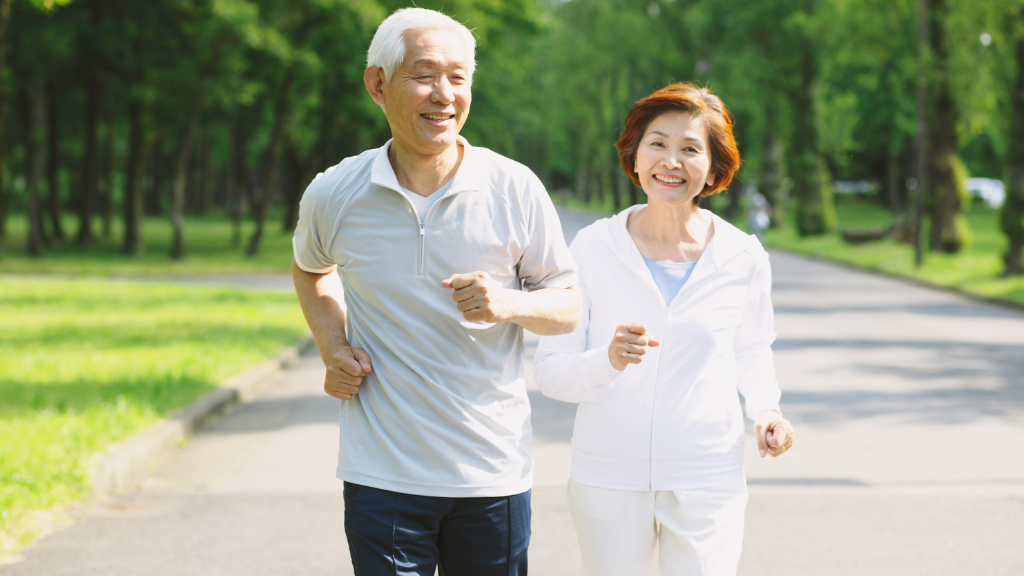
As Asia’s population ages rapidly, organisations across healthcare, agecare, fitness, and social services are searching for effective ways to support older adults in staying active and independent. One growing concern is the increased risk of mild cognitive impairment (MCI) that naturally accompanies ageing. Many studies show that regular Brain Training can help seniors maintain healthy cognitive function and stay mentally engaged.
This article explores the science behind healthy ageing, practical ways to support seniors, and how dual-task training can promote mental sharpness and physical wellbeing.
The Growing Challenge of Ageing and the Role of Brain Training in Seniors

Across Asia, societies are ageing at an unprecedented pace.
- In Japan, people aged 65 and above already make up 29.1% of the population.[1] In Singapore, nearly 1 in 5 citizens is now over 65 — a ratio expected to reach 1 in 4 by 2030.[2]
- Thailand is also entering a “super-aged” era, with its senior population rising steadily.[3]
- By the end of 2023, China had 297 million people aged 60 and above — 21.1% of the population.[4]
As life expectancy grows, many seniors begin noticing changes such as slower thinking, reduced multitasking, or mild forgetfulness. These changes are normal, but when combined with inactivity, they can increase the risk of cognitive impairment.
This is why Brain Training in Seniors is gaining attention. It provides structured, enjoyable mental exercises that help maintain everyday cognitive abilities such as memory, attention, and decision-making.
Why Both Physical Exercise and Cognitive Stimulation Are Essential

Research shows that seniors who engage in regular Brain Training activities often demonstrate better attention, faster processing, and more confidence in daily tasks. These benefits play a meaningful role in delaying functional decline that can accompany cognitive impairment.
However, in many countries, efforts to support brain health often treat physical exercise and Brain Training as separate activities.
While both are beneficial — exercise enhances blood flow to the brain and stimulates the production of brain-derived neurotrophic factor (BDNF), while Brain Training helps maintain mental agility and delay decline in seniors — research increasingly shows that single-domain approaches have limitations, particularly when not tailored to each individual’s abilities and progress.[5]
The Science Behind Combining Cognitive and Body Training

Scientific evidence strongly supports that combining physical exercise with Brain Training produces stronger benefits than doing either alone.
A randomized controlled trial by Duke-NUS Medical School involving adults aged 50 to 75 found that participants who combined exercise with mental tasks achieved greater improvements in attention, language, and memory than those who did Cognitive Training alone. Cognitive outcomes, assessed using the Repeatable Battery for the Assessment of Neuropsychological Status (RBANS) at Week 12, confirmed the superior effects of the combined approach with participants completing 48 one-hour sessions over 24 weeks.[6]
Similar studies also showed that dual-task training improved both gait and cognitive stability in older adults.[7]
In a pilot study targeting elderly individuals at home with mild cognitive impairment (MCI) risk, participants demonstrated significant improvements in executive function, processing speed, reaction time, and cognitive flexibility, confirming the efficacy of integrated training over cognitive or physical training alone.[8]
These findings underline a key principle: body and brain thrive best when trained together.
Simple Dual-Task Activities Seniors Can Train Anywhere

Caregivers and agecare facilities can incorporate these accessible dual-task activities into daily programs:
- March in place while naming animals or foods
- Walk slowly while counting backward
- Hold a balance pose while recalling the week’s activities
- Pedal a stationary bike while solving simple math.
These activities align with Brain Training in Seniors principles. They can help maintain everyday performance and confidence.
The Senior’s Real Challenge: Staying Motivated Consistently

Even when seniors understand the importance of activity, motivation can fade over time. Repetitive routines and lack of feedback are common barriers.
This is why professionals working in agecare are now prioritising programs that are engaging, personalised, and easy to follow.
Recognising this challenge, Neeuro developed NeeuroBike, a solution that unites mind and body training in one engaging experience. The goal: to make proactive brain health care accessible, motivating, and measurable.
A Practical Example of a Tool for Brain and Physical Training in Seniors: NeeuroBike

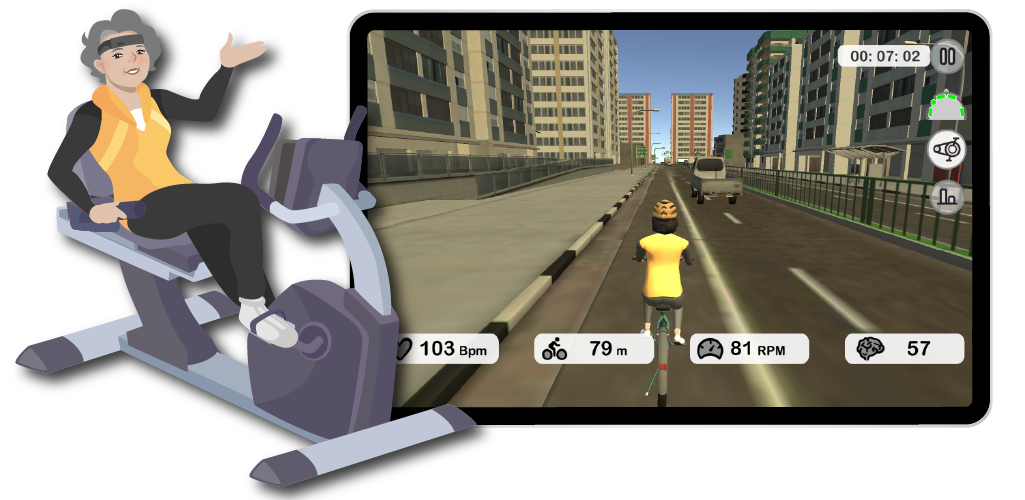
Seniors can pedal on a stationary bike or a seated pedal exerciser while completing cognitive games on a tablet. The comfortable EEG headband “SenzeBand 2” measures brain waves and is used in combination with a cadence sensor that tracks pedaling speed.
NeeuroBike is a solution that combines the SenzeBand 2 and the app and does not include the stationary bike itself — senior centers or gyms can simply use their existing equipment.
The real-time EEG feedback makes each session uniquely personalised. The SenzeBand 2 monitors indicators such as attention and mental engagement during training, helping visualise how the user responds throughout the session. By tracking these patterns, NeeuroBike provides meaningful insights that support a more tailored training experience and help users and instructors monitor progress safely and effectively.
Importantly, NeeuroBike is not a medical solution and does not diagnose or treat cognitive impairment.
Its purpose is purely to encourage physical activity and Brain Training in Seniors in a fun, measurable way that helps seniors stay engaged long-term.
Helping Seniors Overcome Hesitations

For many seniors, the idea of using new technology can be intimidating. Some find brain-training apps repetitive or isolated, while others see traditional exercise as monotonous or tiring. NeeuroBike is the optimal solution for seniors to overcome these barriers, because:
-
There’s no complicated setup: It runs on a familiar tablet. Connecting the SenzeBand and cadence sensor takes only a few taps. -
Safe and comfortable: The SenzeBand only measures brain activity; it never sends stimulation. Seniors who prefer a seated setup can use a pedal exerciser under the chair instead of a stationary bike. -
NeeuroBike transforms exercise into an experience that feels meaningful, not like a chore.
The result is a sustainable way for seniors to stay motivated week after week, with less fear of technology and more joy in progress.
A New Paradigm for Healthy Ageing

Healthy ageing is ultimately about maintaining mobility, independence, and mental clarity. Whether through simple exercises or supportive technologies, combining movement with cognitive challenges is one of the most practical ways to help reduce risks associated with cognitive impairment and promote lifelong wellbeing.
By offering agecare activities that are enjoyable, accessible, and meaningful, we empower them to stay active — both in mind and body — for many years to come.
References
-
- Summary of the Results - Current Population Estimates as of October 1, 2023 Statistics Bureau, Ministry of Internal Affairs and Communications
https://www.stat.go.jp/english/data/jinsui/2023np/index.html - Population in brief 2024, Prime Minister’s Office Singapore Department of Statistics Ministry of Home Affairs Immigration & Checkpoints Authority Ministry of Manpower
https://www.population.gov.sg/files/media-centre/publications/Population_in_Brief_2024.pdf - Thailand’s leadership and innovations towards healthy ageing, WHO
- The State Counsil the people’s republic of China https://english.www.gov.cn/news/202410/12/content_WS6709cb9ac6d0868f4e8ebbda.html
- Acute increases in brain-derived neurotrophic factor in plasma following physical exercise relates to subsequent learning in older adults
- Revolutionising Elderly Care: How NeeuroBike Combines Physical Activity and Cognitive Training to Combat Age-Related Decline
https://www.linkedin.com/pulse/revolutionising-elderly-care-how-neeurobike-combines-combat-alvin-zbokc/?trackingId=H%2Fcla8onRi%2BE2rCdSUokzA%3D%3D - A Combined Cognitive Stimulation and Physical Exercise Programme (MINDVital) in Early Dementia (PubMed) https://pubmed.ncbi.nlm.nih.gov/26913768/
- A pretest-posttest pilot study for augmented reality-based physical-cognitive training in community-dwelling older adults at risk of mild cognitive impairment
https://arxiv.org/abs/2404.18970?utm
- Summary of the Results - Current Population Estimates as of October 1, 2023 Statistics Bureau, Ministry of Internal Affairs and Communications
Take Fitness to the Next Level with NeeuroBike!



Leave a Comment