
Relocating to a new country is one of life's most demanding transitions — and for Japanese professionals and families living in Malaysia, the pressure is very real. A new language, unfamiliar social norms, and the absence of established support networks create a daily layer of stress that rarely gets acknowledged, let alone evaluated.
Yet employers and schools expect full productivity almost immediately after arrival. This gap between the emotional reality of expat life and the performance demands placed on people is where mental health often quietly deteriorates.
It was this environment that inspired the Galini pilot study in Malaysia.
Measuring Stress and Quantifying Therapeutic Responses
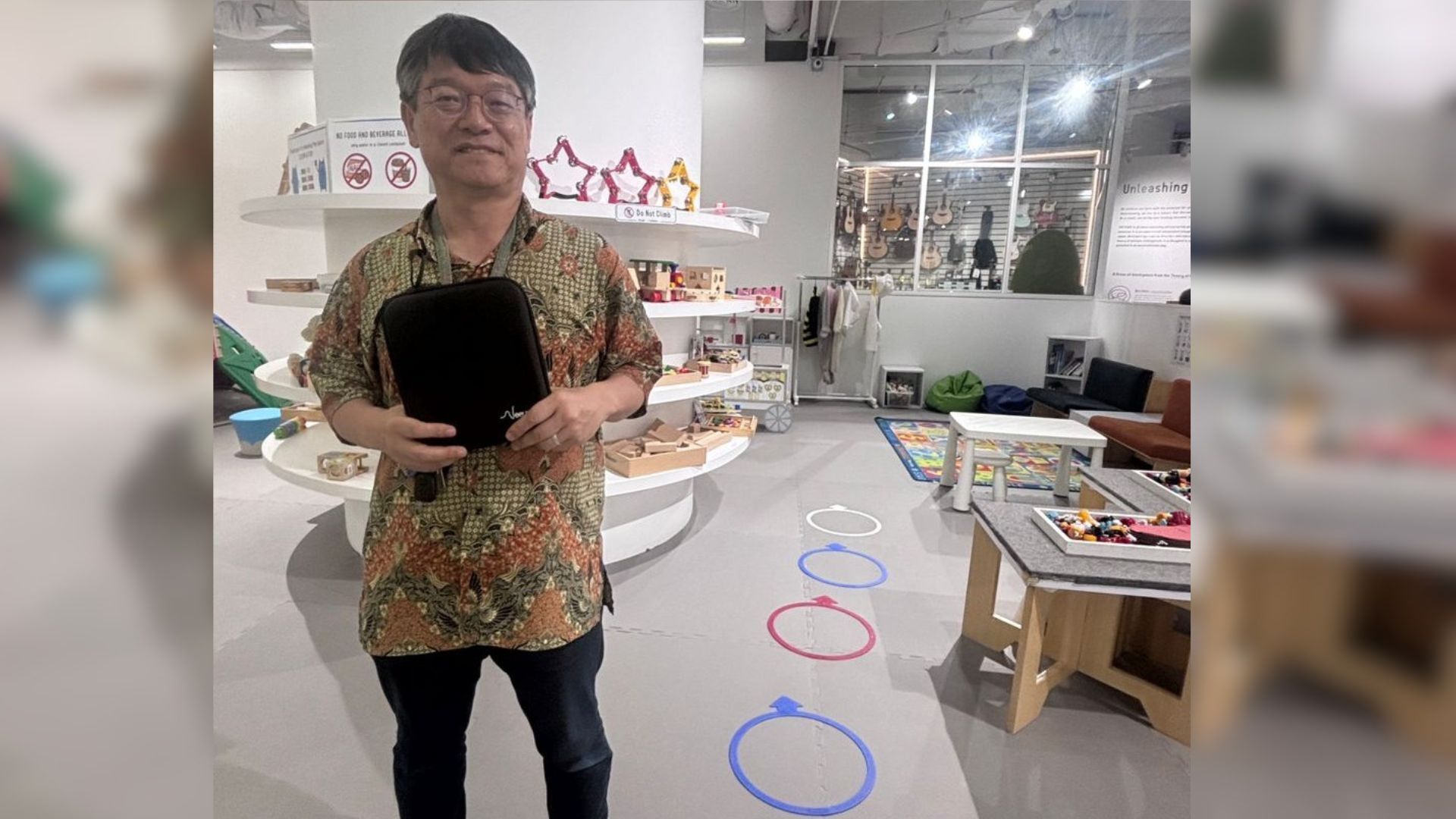
This pilot study in Malaysia was made possible through the collaboration of Mr. Miyoshi, Malaysia's only Japanese clinical developmental psychologist. Based at Toy Eight in Kuala Lumpur, he offers a comprehensive range of child development services rooted in Japanese therapeutic approaches, working not only with Japanese families but with any family seeking that level of care.
Mr. Miyoshi has long incorporated cognitive behavioral therapy and mindfulness into his sessions. However, he says he had been grappling with the challenge that, whilst he could sense the therapeutic response, it was difficult to quantify the effects.
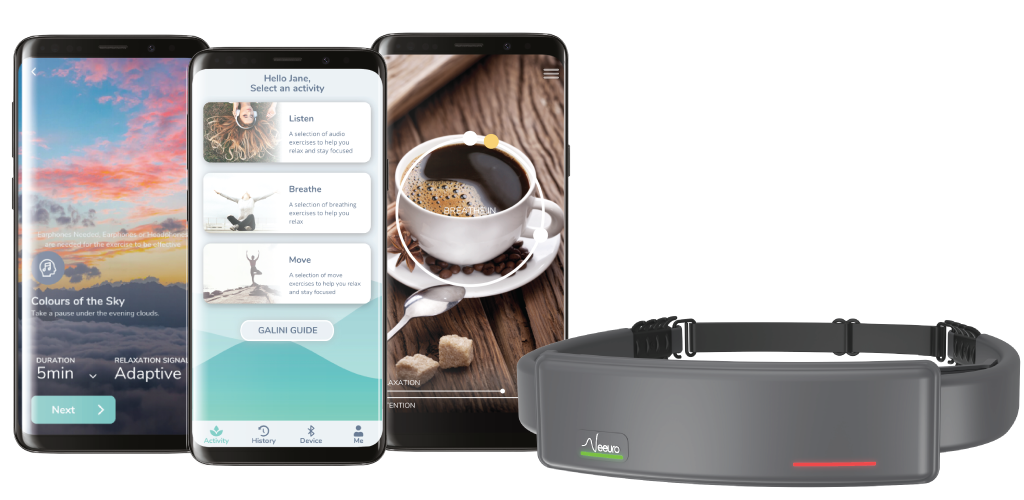
This led him to take an interest in Neeuro’s solution, which combines the SenzeBand equipped with EEG sensors with Galini. The ability to visualise stress levels based on brainwave data was precisely what Mr. Miyoshi needed to address this challenge.
How the Stress Management Pilot Study Worked
The pilot study ran over approximately one month per participant, with five adults from educational institutions and private businesses in Malaysia taking part, all connected to the Japanese expat community.
Participants used Galini and the SenzeBand for sessions of at least 10 minutes, three or more times per week over three weeks. One participant completed the programme using the Galini app only, without the SenzeBand, allowing for a secondary comparison between device-assisted and app-only experiences.
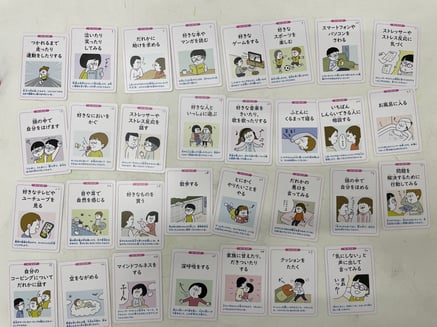 To evaluate psychological changes, Mr. Miyoshi introduced a card-based assessment method. Participants selected from three sets of illustrated cards with Japanese words representing before and after the pilot study.
Examples: Someone cut queue in the cashier
Coping Strategies (C)
Examples: Listen to music, Take a bath
Stress Responses (R)
Examples: Irritated, Hard to sleep in
Changes in the number and type of cards selected were tracked to reflect shifts in each person's subjective mental state.
Results
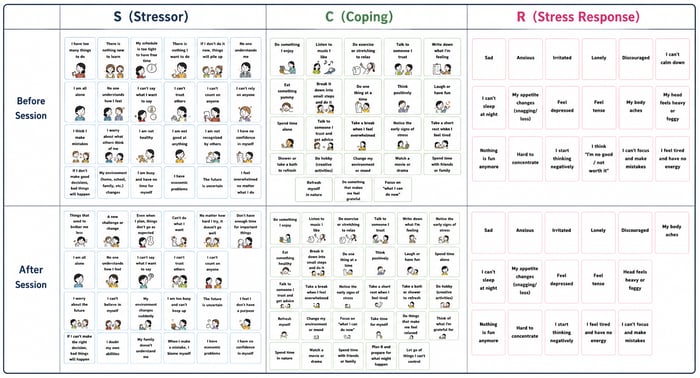
【This result example is translated to English for reference】
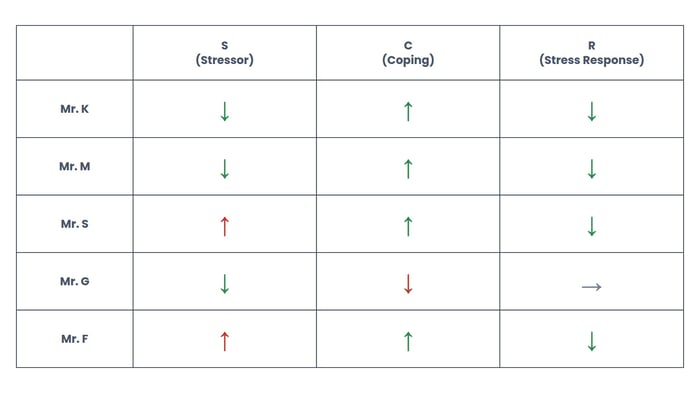
【Pre and Post Comparison of 5 participants' psychological changes based on Mr Miyoshi's card-based assessment method】
 Across the group, results varied by individual, reflecting the inherently personal nature of stress and its management. Majority of participants demonstrated a reduction in self-reported stress responses, and most showed an increase in recognised coping strategies, consistent with the expected direction of change under a cognitive behavioural framework.
One participant showed a marked increase in stressor awareness following the sessions, which may indicate a heightened capacity for self-monitoring rather than a deterioration in wellbeing. In one case, coping strategies decreased in number; qualitative discussion with the supervising psychologist suggested this reflected a shift toward more intentional, self-directed coping, a consolidation of strategies rather than a loss of resources.
.png?width=544&height=110&name=23%20(cropped).png)
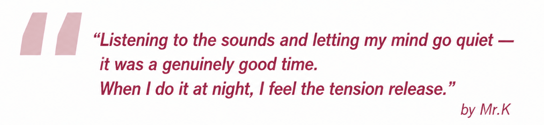
Participant feedback indicated that the ability to observe stress states through objective data was perceived as valuable, with majority noting improvements in sleep quality, reduced physical tension, and a greater sense of calm following sessions. Notably, at least one participant reported spontaneously applying learned breathing techniques outside of scheduled sessions, suggesting early signs of behavioural internalisation.
.png?width=513&height=83&name=24%20(cropped).png)
Key Takeaways and Observations
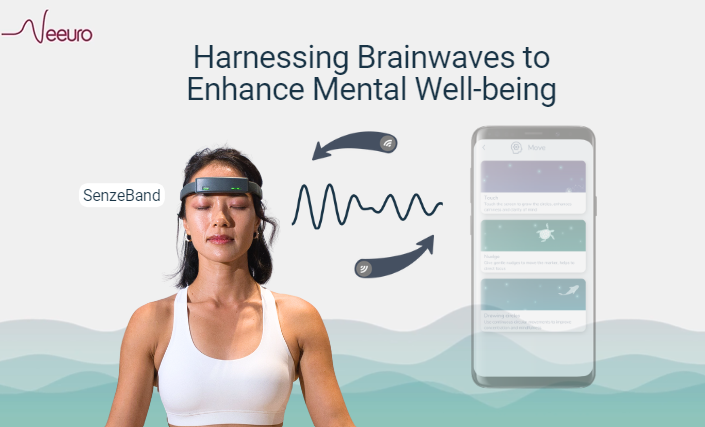 One of the most important factors associated with positive outcomes was home access to the SenzeBand. Participants who were limited to in-centre sessions often spent most of their time simply learning how to use the device, leaving little room to experience its effects. This points to a broader strength of the Galini and SenzeBand combination: sessions can be done anywhere, at any time. For busy professionals, that might mean a 10-minute session during a lunch break, on the commute home, or before bed. The flexibility removes one of the most common barriers to consistent practice.
Mr. Miyoshi also observed that Galini tends to produce stronger results among participants who engage consistently: those who are diligent, responsible, and willing to maintain a routine. This profile maps closely onto many Japanese professionals, who tend to be conscientious and high-achieving, yet are often the last to acknowledge their own stress. These are precisely the people most at risk of burnout, and the ones who stand to benefit most from a structured, data-driven approach to self-care.
Galini's design reflects another important reality: stress management is not one-size-fits-all. Some participants found that turning their phone face-down reduced distraction. Others found closing their eyes improved focus. These individual adjustments are not incidental; they reflect meaningful differences in how people respond to sensory input, and Galini's range of session types, sound-based, breath-focused, and movement-oriented, is built to accommodate them. The objective insights offered by SenzeBand and Galini are complementary to expert's prescribed assessment and therapy/training.
Looking ahead, Mr. Miyoshi sees potential in continuous daily monitoring: understanding which times of day trigger the most stress, how specific environments affect concentration, and how stress accumulates over time. He also sees applications in parenting support, where objective data could help inform more personalised approaches to parent training and family wellbeing.
Closing Thoughts of Stress Management Pilot Study
The findings from this pilot study highlight: when people are given the right tools at the right time, meaningful change is possible, even within a single month.
For organisations operating in high-pressure environments—whether international schools, multinational companies, or communities supporting people through major life transitions—the challenge is rarely a lack of awareness. Most people know they are stressed. What they lack is a practical, sustainable way to do something about it. Galini addresses that gap by making stress management measurable, personalised, and accessible within the rhythms of daily life.
When wellbeing support fits around a person’s schedule rather than adding to it, it stops feeling like an obligation. It becomes a practice people return to, not because they have to, but because they can feel the difference.
■ Click here for more details on Galini and SenzeBand
https://www.neeuro.com/ja-jp/solutions/stress-management/galini
Galini
Be on your Way to a Stronger and Healthier Brain with Galini.
Paired with the Revolutionary SenzeBand 2.



Leave a Comment